
Classic multiplayer games and the evolution of gaming offer unmatched stability and liberation, free from endless updates and shifting metas.
I stand at the crossroads of virtual realms, a seasoned traveler through countless digital battlefields. The year is 2026, and as I gaze back at the evolution of multiplayer gaming, I find myself drawn to the elegant simplicity of yesteryear. Like ancient poetry carved in stone, classic multiplayer games remain unchanged—perfect in their completion, undisturbed by the relentless tides of updates and revisions.
The recent whispers about Back 4 Blood's support ending reminded me of how our expectations have shifted. We've become accustomed to games that never truly finish, that transform beneath our fingers like clay never allowed to harden. Yet before Fortnite's endless seasons and Overwatch's questionable sequel status, multiplayer games simply... existed. Complete upon arrival. Whole.
The Dance of Permanence
When I boot up Star Wars: Battlefront from 2015 on my Xbox, I enter a world of certainty. The maps—vast and limited in number—reward my familiarity like old friends. I know each corner, each vantage point. The players who abuse the bolt rifle and jetpack are countered by precision and strategy developed over years, not patches. There's poetry in this permanence, a rhythm to gameplay that doesn't require relearning with each season.
I remember Symmetra in original Overwatch—my digital extension, my tower-defense artist within a shooter canvas. Twice she was reborn under the knife of developer intervention, transformed into something unrecognizable to please the vocal masses. My money spent, but my experience erased. This is the tragedy of games as services:
-
Your favorite character—redesigned
-
Your preferred mode—buried beneath new content
-
Your mastered strategies—rendered obsolete by balance patches
The Liberation of Completion
The absence of grinding feels like freedom now. I've watched too many sunsets chasing artificial level caps that rise like horizons that never arrive. Classic multiplayer games offer liberation:
-
No endless battle pass progression
-
No meta shifts requiring constant adaptation
-
No fear that your favorite mode will vanish tomorrow
-
No anxiety about missing limited-time events
Quake Champions stands as testament to this philosophy. After exiting early access, it simply... exists. It doesn't demand my constant attention or threaten obsolescence if I step away. It is content in its completeness, like a well-crafted sonnet that needs no additional verses.
The Symphony of Stability
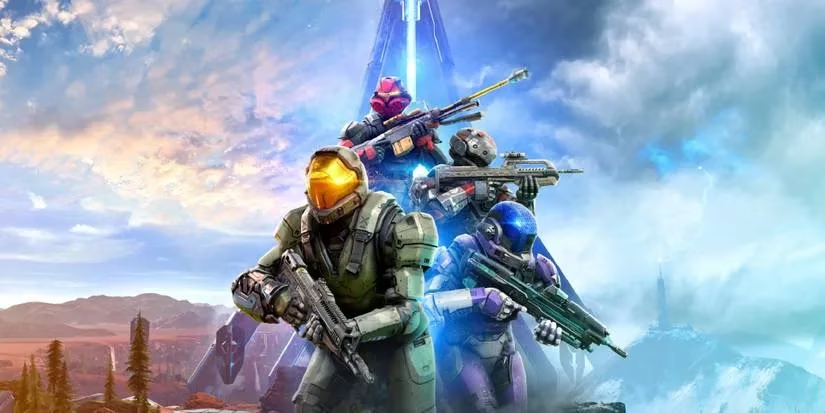
The Master Chief Collection sings with harmony that Halo Infinite's live-service model struggles to find. MCC offers classic content in stable, accessible form—a digital museum where exhibits don't randomly change overnight. Its occasional new maps and cosmetics enhance rather than redefine.
I've witnessed communities flourish around games untouched by patches for years. They develop their own counterplay, their own traditions, their own legends. There's something profoundly beautiful about players mastering a static system rather than chasing a moving target.
The Poetry of Play
When I return to these older multiplayer experiences, I find a certain peace. The game I left is the game I return to—unchanged, unwavering. In 2026, as developers race to create ever-evolving digital worlds, I find myself appreciating the stillness of completed works.
These games stand like ancient trees in a forest of saplings—deeply rooted, branches reaching skyward, unchanging yet eternally engaging. They offer:
-
🎮 Consistent experiences that reward mastery
-
🕰️ Nostalgia untainted by revision
-
🧠 Strategies that remain relevant years later
-
👥 Communities built around shared, stable experiences
The Freedom from Virtual Labor
Most crucially, these games never transformed into second jobs disguised as entertainment. They never demanded daily logins or weekly challenges. They asked only that I play when I wished, how I wished.
I reached mountaintops in games like Gotham Knights and, should I wish to scale those peaks again, the path remains unchanged. The journey awaits exactly as I remember it—no new obstacles, no altered terrain.
The dedicated players still enjoying Star Wars: Battlefront, classic Halo, and other "complete" multiplayer experiences aren't there because of FOMO or progression systems. They return because the fundamental gameplay loop—that core experience—remains genuinely fun.
The Eternal Return
As I navigate gaming in 2026, I find myself regularly returning to these completed works. Like favorite books I revisit, knowing each word but finding new meaning, these games offer comfort in their constancy.
While I wouldn't decline new content for beloved classics, I question whether they truly need it. Entertainment value doesn't require constant expansion. Sometimes, the most poetic experiences are those that know when they are finished—complete verses rather than endless improvisations.
I'll take a completed symphony over an eternal jam session any day. In the quiet spaces between the noise of battle passes and seasonal updates, I find the true music of gaming: play for the sake of play itself.