
Explore the dynamic evolution of the tank meta and Orisa's role in Overwatch 2, revealing powerful new strategies for competitive gamers.
I've spent the better part of my gaming career gravitating toward tank roles, finding satisfaction in absorbing damage and protecting teammates while the DPS players rack up kills. There's always been something deeply rewarding about being the unsung hero, the foundation upon which victory is built. But as we move through 2026, I've come to appreciate how much the tank meta has evolved across gaming—particularly through my experience with Orisa in Overwatch 2.
When I first started playing competitive team shooters, I was drawn to traditional defensive tanks. Reinhardt in the original Overwatch became my first love—that massive shield providing a mobile fortress for my team felt like the purest expression of the tank role. I was content to be the immovable object, the wall between my team and certain defeat.
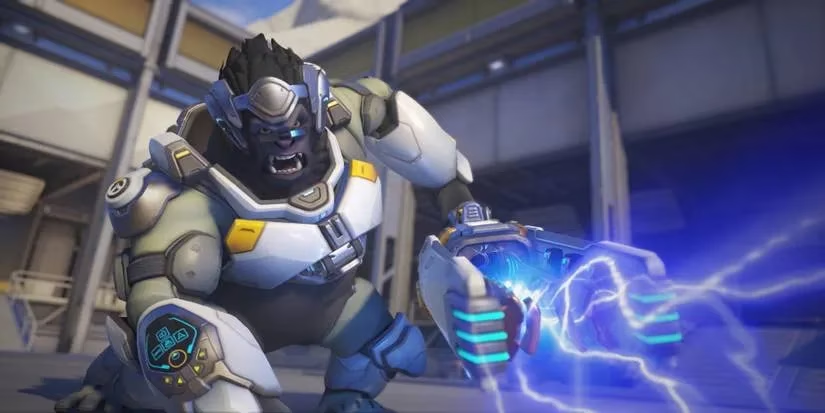
Then came Orisa, who quickly became my main. Her defensive capabilities and team-supporting toolkit perfectly aligned with my understanding of what a tank should be. I was comfortable in my role as the team's protector and enabler.
But everything changed with Overwatch 2's dramatic rework of Orisa back in the day. Initially, I was devastated. My beloved shield-bearing guardian had been transformed into something more aggressive, more offensive-minded. Her static barrier was replaced with a temporary spinning javelin shield, her crowd-control orbs became a single-target javelin throw, and her ultimate transformed into a vortex of destruction. It felt like a betrayal of everything I thought a tank should be.
For months, I stubbornly refused to adapt. I wanted to be the defensive anchor for my team, not another damage dealer. But after countless matches of struggling with traditional tank approaches in the new meta, I finally decided to give the reworked Orisa a genuine chance.
The Turning Point
The epiphany came during an intense standoff against an enemy Reinhardt protecting a damaged Mercy. In the old days, that Mercy would have been untouchable behind Reinhardt's shield. But with my new toolkit, I charged forward, activated my spinning javelin shield, and bulldozed through their formation. The shield knocked Reinhardt aside, allowing me to eliminate the Mercy and create an opening for my team.
That moment changed everything. I realized tanks could create space not just by absorbing damage, but by actively disrupting enemy formations and forcing advantageous engagements.
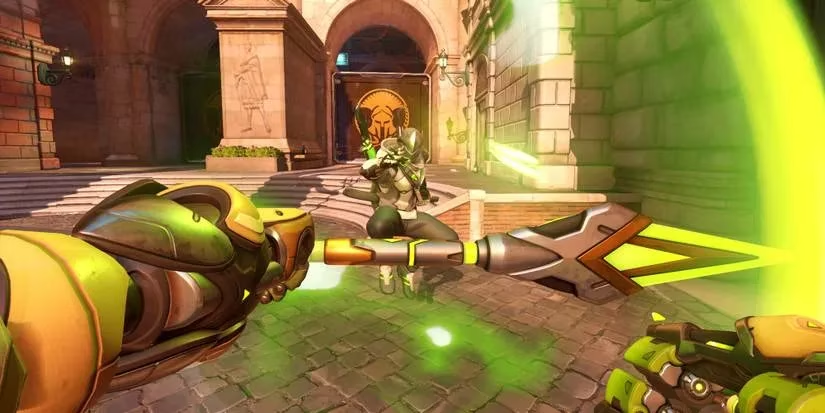
The javelin throw became another revelation. As someone who never considered myself particularly skilled at precision aiming, mastering this ability took dedication. But the versatility it offered was worth the effort. I could pin fleeing supports to walls, interrupt ultimates, create distance from aggressive enemies, or secure eliminations on targets just out of reach.
What's fascinating about this evolution is how it's reflected across multiple games in recent years. The industry has increasingly embraced this hybrid tank concept—powerful frontliners who create space through aggression rather than pure defense. Games like Valorant, Apex Legends, and even traditional MMOs have been incorporating elements of this design philosophy.
Beyond Just Soaking Damage
The beauty of modern tank design lies in its versatility. Today's tanks aren't just damage sponges—they're playmakers who can:
-
🛡️ Provide strategic protection at critical moments
-
⚔️ Initiate advantageous engagements
-
🔄 Disrupt enemy formations and strategies
-
👥 Create opportunities for teammates to capitalize on
-
🎯 Secure eliminations on high-priority targets
I've come to appreciate how this design creates more dynamic gameplay. As a tank player in 2026, I'm no longer content to simply exist as a barrier between enemies and allies. I want to dictate the flow of combat, to be the spearhead that breaks enemy lines and creates opportunities.
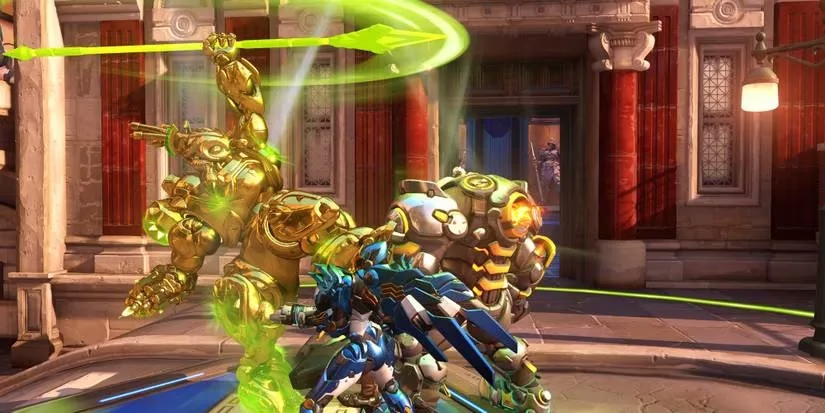
What I love most about this evolution is that it hasn't abandoned the core tank identity. Modern tanks like the reworked Orisa still have protective capabilities—they just deploy them more strategically rather than maintaining them constantly. Her spinning javelin shield might be smaller and temporary compared to her old barrier, but it's more impactful when used at the perfect moment to negate a key enemy ability or protect a teammate during a crucial push.
Even her ultimate ability, which pulls enemies toward a central point, exemplifies this hybrid design. It's simultaneously aggressive (disrupting enemy positioning and making them vulnerable) and supportive (setting up teammates for devastating combo plays).
The Ripple Effect Across Gaming
This paradigm shift hasn't been limited to Overwatch. Looking at the gaming landscape in 2026, we can see how this philosophy has influenced tank design across genres:
-
MMORPGs have moved away from the pure "aggro management" tank model toward more interactive designs
-
MOBAs have embraced initiator tanks who create opportunities through aggressive positioning
-
Even single-player RPGs have incorporated more dynamic "tank" builds that balance offense and defense
The days of tanks being relegated to passive damage absorption are behind us. We've entered an era where frontliners are expected to be dynamic playmakers, combining protection with disruption and elimination potential.
For players like me who initially resisted this change, the journey has been revelatory. I've discovered that protecting my team doesn't always mean standing in front of them with a shield—sometimes it means eliminating threats before they can harm my allies, or creating chaos in enemy ranks to prevent coordinated attacks.
As we move further into 2026, I'm excited to see how game designers continue to evolve the tank role. The fusion of offensive capability with defensive utility has created a more engaging experience for players who want to lead from the front without sacrificing their team-oriented identity.
So if you're like me—someone who has always been drawn to tank roles but felt limited by their traditional implementation—I encourage you to embrace this new paradigm. There's an incredible satisfaction in being both the unstoppable force and the immovable object, in protecting your team through aggression rather than just absorption. The tank meta has evolved, and I couldn't be happier about it.